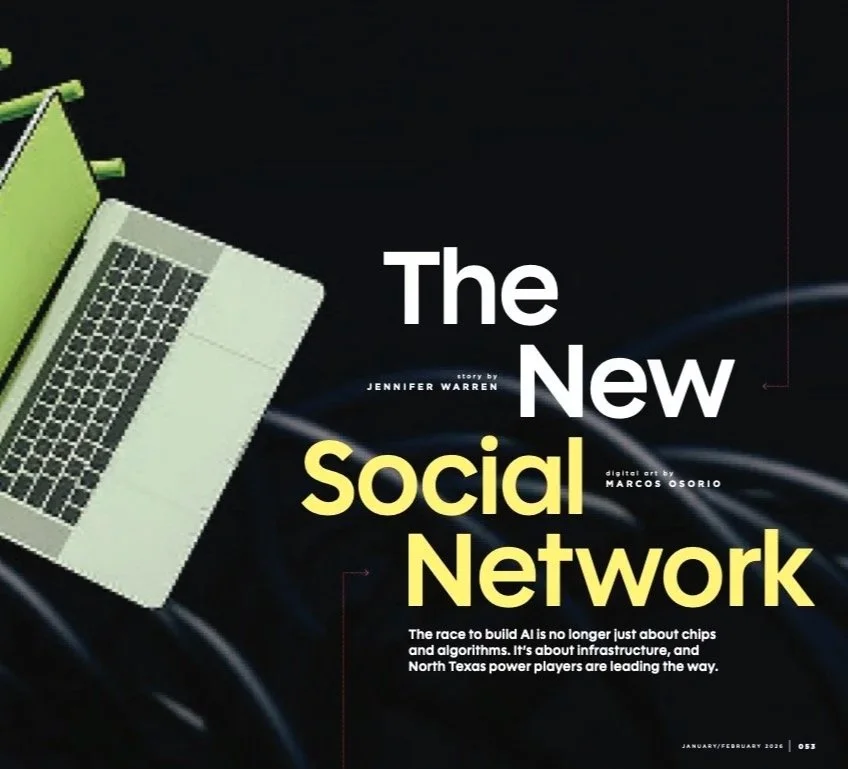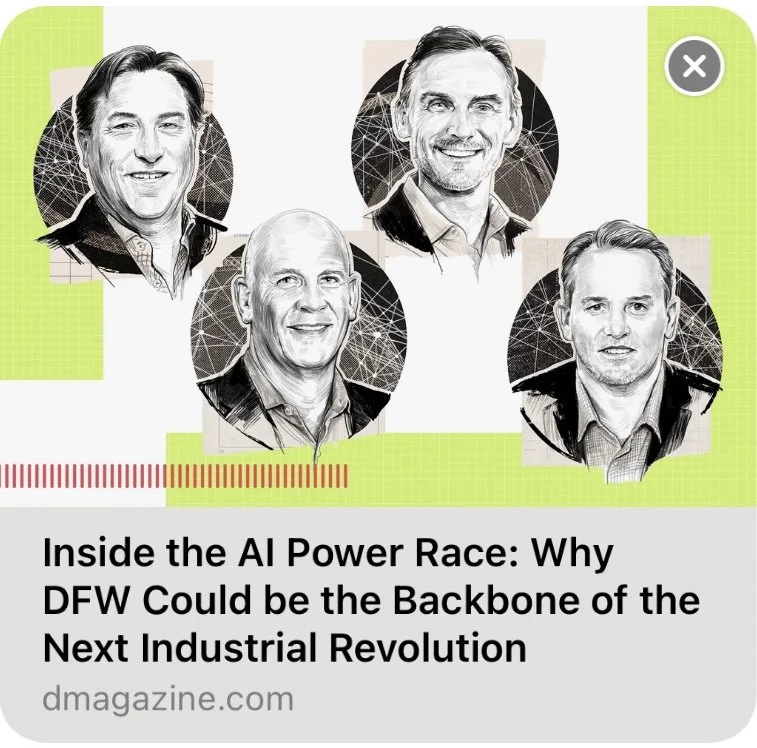
“The New Social Network”
Digital version here.

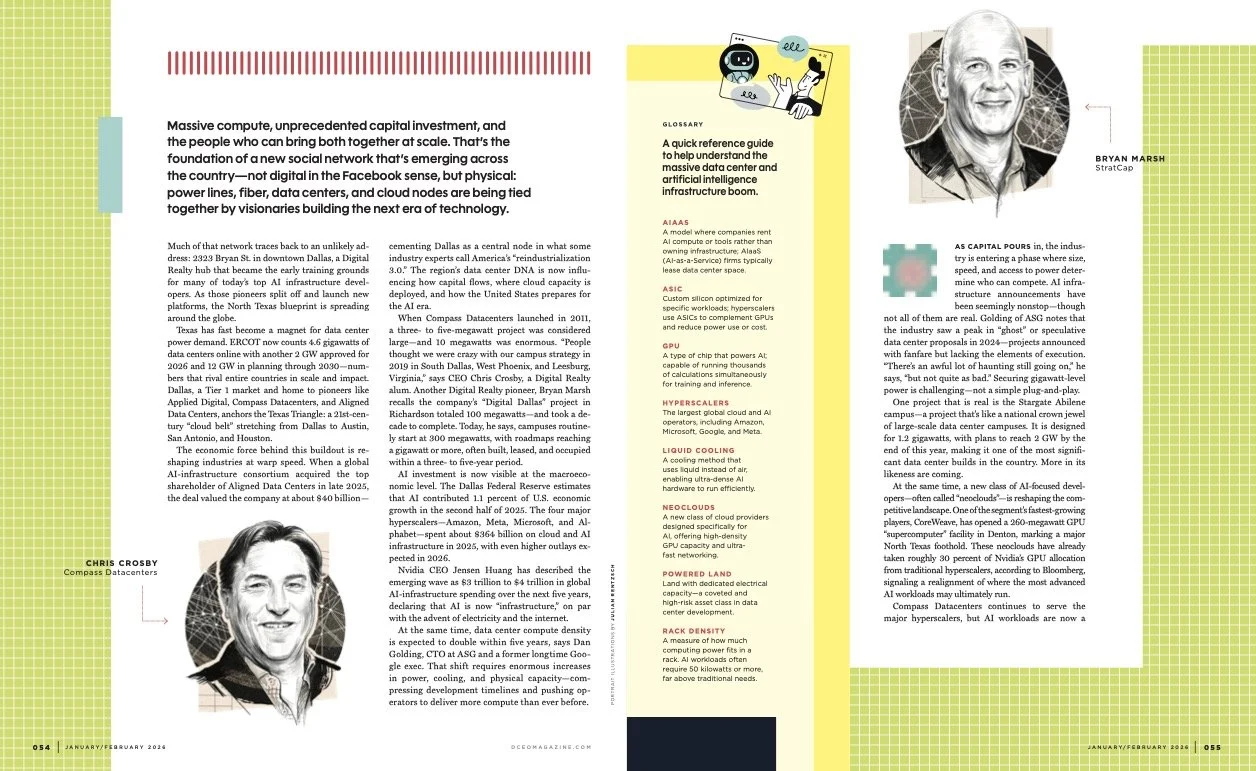
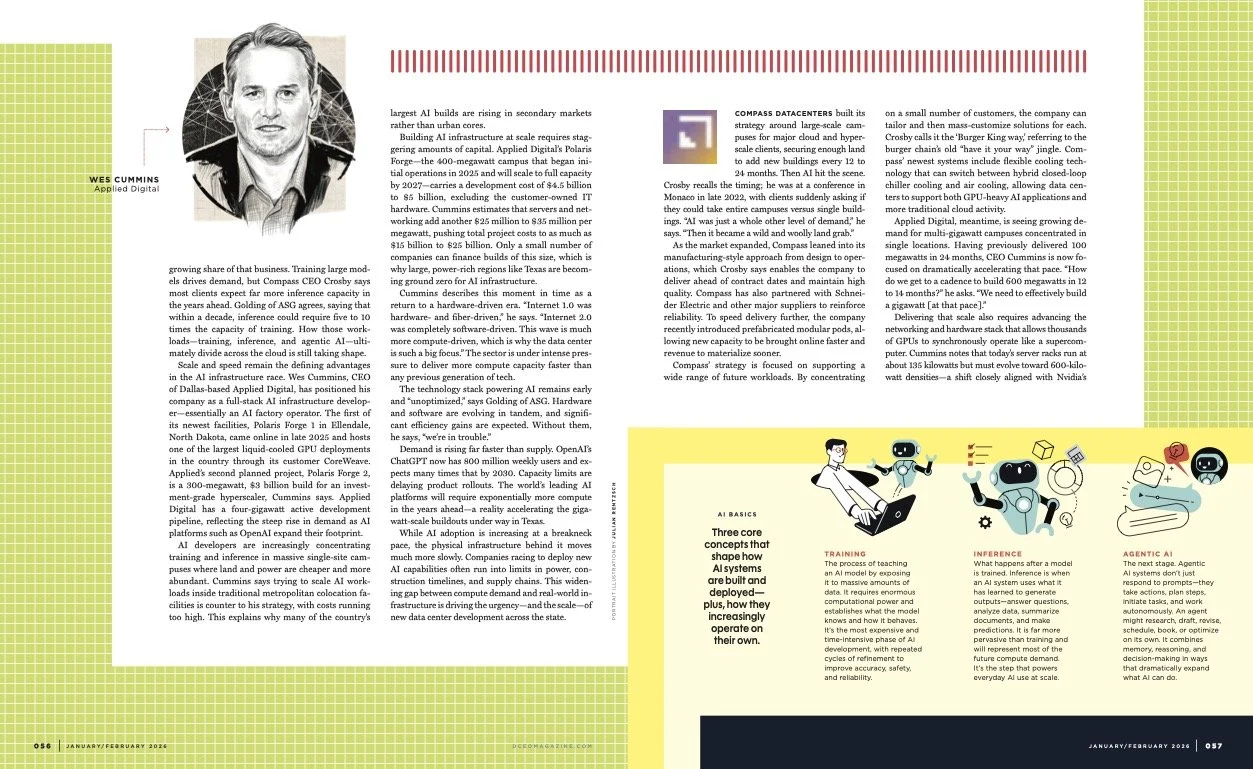
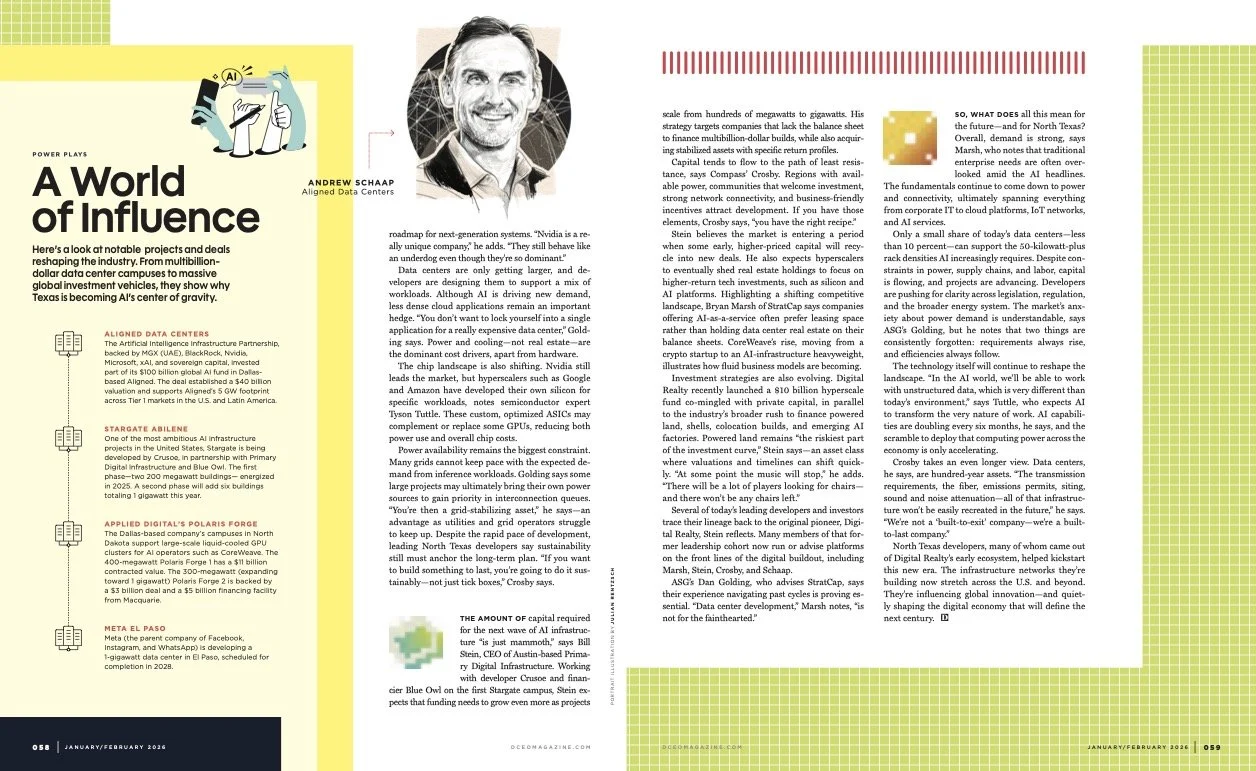
Print PDF version with the theme…
The feature in the January-February 2026 edition of DCEO Magazine is a sequel to the March 2025 feature "The Really Wild AI Ride." That feature represented about two and a half years of work focusing on what was happening with generative AI, semiconductors (chips), the emergence of more data centers and increased capex spending by big tech.
Playing that story forward represents an immersion of the last six to eight months, trying to make sense of the AI infrastructure buildout. Many big tech firms, including NVIDIA, have adopted the term "AI infrastructure" because it describes what's happening in a way people can relate to.
I've been writing about energy infrastructure and digital infrastructure for well over a decade, so it was natural for me to segue into this digital infrastructure world from the energy world. As we know, energy is integral to the success of the AI infrastructure being built right now.
Behind the feature “The New Social Network” in DCEO Jan/Feb 2026
Theoretical Framework

The Inspiration Behind the Concept
In the feature, I'm witnessing and trying to describe the transformation at hand. I also pay homage to some inspiration behind my thematic approach to capturing this phenomenon.
I go back to a 2012 interview with theoretical physicist Dr. Geoffrey West. He was president of the Santa Fe Institute, a progressive think tank. I invited him to the Dallas Committee on Foreign Relations when I was running it. I interviewed him about an academic article and theory he had developed. The book that ensued in 2017 is called "Scale," but I interviewed him five years before it came out, so I was privy to his early thoughts.
““After all, what’s the whole point of cities? The point of cities is to bring people together—to interact and create new things; it’s a facilitator. The infrastructure is actually a facilitator for human interactions. As a facilitator, it would be sensitive to the dynamics of that social network.””
In that interview, he said: "The physical infrastructure is reflecting the social networks of cities." That describes this infrastructure build-out we're seeing. It's driven by technology, but people are really at the core. The North Texas entrepreneurs in the feature are part and parcel of that. They're the pioneers seeding this digital economy growth—spreading it locally, nationally, and around the globe.
It's fascinating, and obviously accelerated by generative AI. The potential for increasing productivity and GDP is there. But in some respects, it's just the next leap forward in technology—the nature of innovation. It's happening at a more rapid pace than even the last iteration of the computer age and internet age. This is another age within that genre.
Constructing the story
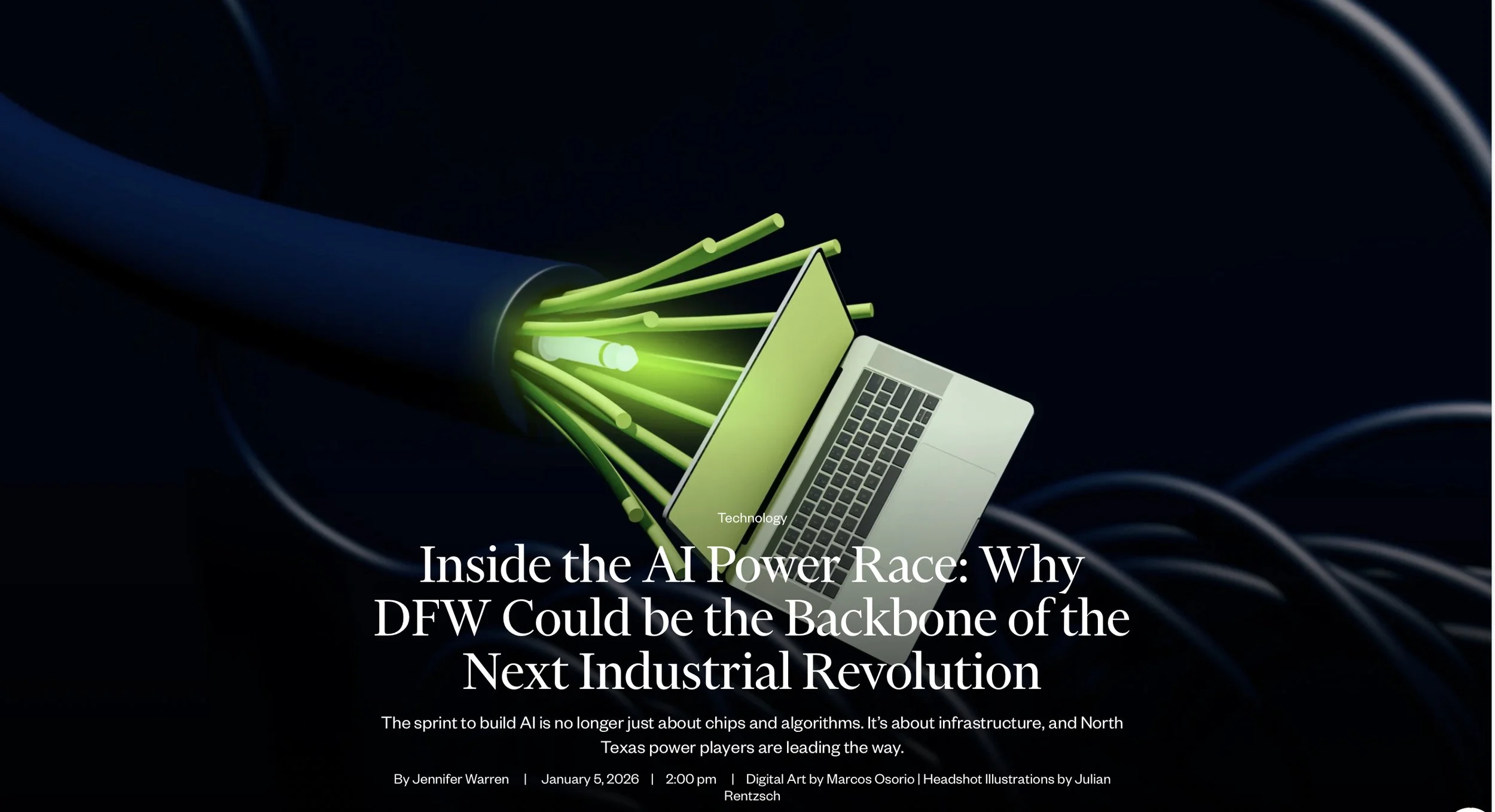
Online version
I was trying to figure out how to describe something that's really in its early days. I had to work with the resources at hand, which meant North Texas entrepreneurs and the various data center developers I knew from my last feature. I had also written an energy feature where I interviewed Digital Realty's Andy Power in the summer of 2024, which landed me on the path of identifying where ground zero is in Dallas, Texas for AI infrastructure and data center developments.
In constructing this, I looked at semiconductors since we have Texas Instruments here. But as I thought through it and examined the supply side of the AI infrastructure build-out, I felt that for North Texas, the chips conversation wasn't what was material to the patterns I saw developing.
What was actually a motivation was that big tech was spending a lot of capex—documented in the last feature but continuing and growing. They're the ones really supporting this build-out, and the data centers being built at scale reflect that. Thus capital allocation became an important factor in the feature.
Beyond AI Workloads
It's not just AI workloads driving all of the infrastructure development. These are data centers—digital infrastructure. Yes, there are AI workloads, and increasingly they'll take up more space in new builds. But there's also growth in cloud computing, businesses and enterprises adopting AI and new technology, plus more migration to the cloud. There's significant growth in that space of the economy.
When you talk about businesses adopting AI and being part of the equation of AI diffusing throughout the economy, it also has to do with people. People are using generative AI—ChatGPT, Claude, and other tools. You see this whole shift into utilizing this new technology. I think that adoption won't be linear. There will be many factors related to resources, capital, and adoption.
The North Texas Players
All the data center developers I interviewed had their heads down working this out. Many came from commercial real estate and grew into data center development because it was an offshoot of commercial real estate—using real estate differently. That's continuing, but other players have come on board, like the crypto mining sector. They know how to build this infrastructure and they're savvy with HPC (high-performance computing), so it's a natural fit.
Capacity is at a premium. If there's already built infrastructure that can be upgraded or modified to handle AI workloads, it's highly sought after and highly valuable. You've seen crypto miners moving into the space, and we have that in spades in Texas.
You have this natural fit of data center developers—some from Digital Realty in Dallas—and crypto miners, many of whom are here. There's a core of expertise and knowledge in North Texas, which is fascinating to see.
Historical Parallels

This AI infrastructure build out reminds me of the shale revolution. That also originated with knowledge, capital, and pioneering in North Texas with the Barnett Shale, then spread throughout Texas, the United States, and around the world. There are analogues between energy infrastructure development and the digital economy reflected by digital infrastructure and AI infrastructure. Patterns are starting to emerge.
That was one of the things about this article—I was trying to wrap my head around the picture that's developing. We hear different headlines and there's focus on electricity prices and various issues. But that's not the whole story. The story is much larger. This feature reflects what's happening, where things are going right now, and where things will go.
I think it's going to be fits and starts. There will be a lot of digestion phase ahead because there's been significant capital spending announced and many data centers on the books that have to get executed, along with technology that has to be adopted.
I hope you enjoy the read.
Full Podcast: Clips and Behind the Scenes
““The physical infrastructure is reflecting the social networks of cities.””
takeaway: Digital infrastructure and the data centers emerging are a new breed of infrastructure that reflect a changing economy and the social networks inherent in it.