



Novel research sheds light on the optimal design of “uncapped” initial coin offerings (ICOs), meaning that an unlimited quantity of tokens is offered on launch day. Read more here about the research I profiled.
Sustainability Advances from Energy Transition Events
The news of Exxon’s shareholder vote resulting in two new board members owing to activist Engine No. 1 and Shell’s ruling to cut its greenhouse gas emissions by 45% by 2030 serves as a milestone for the beginning leg of sustainability’s marathon. Numerous countries, firms and other entities have pledged to be net zero by 2050. Over 60% of countries and 20% of Forbes-listed firms with sales near $14 trillion have committed to net zero goals; however, only about 20% meet robustness criteria set forth by the U.N.’s campaign standards. Still, in the realm of momentum and sentiment, the signs are more promising.
Further changes are afoot in investment activity in response to managing portfolio risk related to climate change. Bond investors in Europe are positioning themselves ahead of anticipated changes to monetary policy, according to the Wall Street Journal. Credit analysts and strategists suspect the European Central Bank, Bank of England and other central banks may tilt their bond-buying programs toward sustainable companies. They attribute the widening spreads to these potential policy changes. Though oil prices have increased, which typically tightens spreads of the past, they are widening, even among the Majors like BP, Total and Shell with the more advanced pledges of carbon emissions reductions.
This is very interesting for the future of asset prices related to risk management. We know that ESG investing is a matter of screening firms for environmental, social and governance factors. There is also variance in its application by firms and authoritative bodies globally. Convergence on standards may allow for better comparisons over time, but expect asymmetries to exist for some years. In a recent ESG conference, experts in policy, academia and institutional investing echoed the observation of divergent standards in Europe and the U.S., even within large swathes of participants by industry. Thus, top-level policy changes and firm-level responses to trends offer a confluence of events that will increasingly shape and hopefully ground asset prices.
The whipsaw of financial markets between sustainable-oriented or green firms and “the rest” has not been grounded in today’s reality on a macro level. The spaces in-between and the divergences in practices offer new opportunity for thoughtful investors—and new strategies for firms carving out their positions—in the evolution of sustainability investment and its many manifestations.
Technological-Induced Creative Destruction on Tap
After attending the annual technology-enabled disruption event produced by the Dallas Federal Reserve Bank, several key ideas emerged about macro- and micro-level trends. As the U.S. currently sits at the beginning of the end of the pandemic (hopefully) from vaccinating its way through it, some businesses have advanced their own digital economic footprint faster than they might have otherwise. It has implications for monetary policy.
Pepsi Co’s Stephen Williams mentioned that his firm is as much a technology firm as a consumer goods firm, increasingly leveraging artificial intelligence (AI) in operations. He suggested that they are five years ahead of where they thought they would be in their digital and technological progress. We know the pandemic has unleashed a torrent of online shopping and business activity since March of 2020. He further mentioned that AI is here to stay, improving blue-collar jobs but also impacting white-collar ones as well from their on-the-ground perspective.
‘Data is the new oil,’ noted academic Diane Coyle of Cambridge University. I’ve also heard it said as ‘information is the new oil.’ Her observation —information needs tacit knowledge to be used —conveyed a most important truth that is often overlooked. We still need human intelligence to apply the mountains of information being gathered by our computerized extensions of ourselves. Big data needs a visible hand in its laissez faire endeavors of gathering insights and applying them.
Of course, it would not be a Fed conference without a question being asked about the Fed’s inflation outlook and their thinking about interest rates and securities purchases. The current economic climate as it relates to monetary policy can be characterized as uncertain. Dallas Fed President Robert Kaplan says that a key watchword for him is risk management. An example given was to consider the benefits of Fed stimulus (interest rates and securities purchases) versus the unintended consequences. One such sign noted by Kaplan was that investors were competing with home buyers in the red-hot housing market. Witness the home price appreciation in markets throughout the U.S., with an increased demand (and availability of low-interest rate capital) pressuring a limited supply from pandemic economics and work-life behavioral shifts.
Richmond, Virginia’s Fed President Barkin observed that the pursuit of productivity was everywhere. He expects more businesses to automate operations to replace labor versus businesses raising wages to attract workers. My inference is that there will be more dislocation of certain types of jobs. On the flip side, the technologies that replace these types of positions will usher in new upskilled roles for replaced workers.
In general, technological advances have pushed inflation down over the last decade or more, a cyclical force which has been proven by research and cited in the earlier conferences. The labor issues at hand with technology are structural in nature. The pandemic’s effects on unemployment have therefore collided with changes already in motion in the labor market. This may mean that the current unemployment scenario (mentioned at 8 million) will take longer to rebalance. The states rolling back unemployment federal benefits may be giving up demand support at the expense of the anecdotes and voicings by businesses to find low-wage workers. TBD.
Atlanta Fed President Bostic expects a turbulent transition, with markets currently experiencing volatility. Inflationary pressures, those which are transitory versus permanent, are challenging to disentangle at present. The inference, and supporting statements, is that the decision to raise interest rates or reduce securities purchases cannot be decided based on one quarter’s data set.
The macro forces of technological advances might be considered an abstraction in some ways. However, as this touches every consumer, business, and institution, displayed in very concrete terms during the pandemic, it shakes the investment case and rationale in virtually every industry. We observe this in the gyrations of the stock markets as investors sort through what type of creative destruction is really happening.
(My next post will attempt to overlay some of these observations onto the energy transition and sustainability space.)
Energy in the Time of COVID
After my listening tour from various expert presentations, I attempt to parse the state of demand, the energy transition and what it means for future investment on Seeking Alpha. (Here.)
ESG in Energy and Virus Hits China's Oil Demand
ESG in Energy
As large firms like Blackrock add more sustainable-oriented offerings to their product lines, an energy transition continues. Summary points follow.
• Behemoth investor Blackrock announced a tougher stance on climate risk disclosure.
• Increasingly, the large- and medium-cap energy firms will solidify and mature their positions with respect to ESG principles.
• The timing of the energy transition is challenging to identify but the fundamentals still apply.
See the editor’s pick full article on Seeking Alpha.
Coronavirus and Oil Demand
In other economic news, the coronavirus has trickled through to oil demand in China and elsewhere. Select summary points follow.
• China's influence in the global economy has grown since the SARS outbreak, highlighting a bigger hit to the more highly-interconnected global outlook.
• OPEC is debating further production cuts to shore up oil prices and budgets.
Read the article.
Oil Co Eyes Lower Carbon Future
In a brief radio interview with Boston’s Financial Exchange program, I offer a glimpse of the energy transition underway relative to one Permian player that is also globally diversified, Occidental Petroleum.
Fed Chairman Powell in Dallas
Last night at the Dallas Federal Reserve Bank, Chairman Jerome Powell answered questions posed by Dallas’ President Robert Kaplan. I found Chairman Powell exactly the kind of leader one would want in that position—a studied approach, open to multiple viewpoints, a listener, but also clearheaded in his role to serve the public given his mandate by Congress. He visits Capitol Hill frequently but also engages with the 12 districts to hear on-the-ground news of business practitioners. His apolitical stance is refreshing and encouraging. His job is to hold watch over the American financial system, deeply connected to the globe’s, with an objective, transparent, steady approach. He is a man for the times. Some key paraphrased comments follow:
In the future, a press conference will be held after every FOMC meeting rather than the four currently. This means that interest rates could be adjusted at any meeting. He mentioned that over eight years, there was no change in the federal funds rate, and now we are around 2-2.25%, in an attempt to normalize monetary policy. Inflation is on target, he mentioned, and he was positive about the economy. He understands the delicate balancing act between raising rates too fast or slow, each with their own unique challenges to monitor in terms of markets and economy. Ie., the pacing and amount of rate change are the factors.
Chairman Powell said his primary goal with respect to the economy is to extend the economic expansion we have witnessed over the last many years. The Fed will continue to reduce its balance sheet as well. Referring to his recent Jackson Hole, Wyoming speech, he said his message was simply to bring the idea of risk management to the fore. When presented with uncertainty, you take a slower thoughtful approach. A Marketplace reporting noted, “The slowing housing industry — which Powell pointed out is not simply about rates but also a scarcity of lots and labor — was also mentioned. Powell noted that many Americans have never lived in an environment of high mortgage rates.” However, housing has become less of an [economic] driver than in the past. It’s still a forward indicator.
On the trade front, Powell said that the new tariff policies have not shown up in the data yet. But he has heard from business leaders about the higher costs associated with the policies. He also noted that often businesses observe trends in costs and inflation before the data reveals the trend. Monetary policy is guided by both the anecdotal and the evidence in the data from the economic activity across the entire country and Fed banking system. It remains to be seen how the trade policies play out—whether it’s the case of fairer and freer trade or greater protectionism that means less growth and higher inflation.
The global economy is showing signs of a slow down. Half of economic activity involves emerging and developing markets, he mentioned, and a large part of their activity comprises global GDP growth.
A main observation made by Powell about the recession and financial crisis was the lack of imagination. People and policymakers did not see the vulnerabilities in the financial system. In a warning, he noted that the U.S. is on an unsustainable path fiscally, with high debt-to-GDP levels. The health care system and spending on entitlements need to be addressed.
His presentation of fact and inferences was sober and credible. Powell is a credit to the American economy and to global financial leadership.
Energy Investing and Economy
Recent work features a blend of economic and business trends. In energy, the direction of oil prices continues to weigh on investors, while new policies clash with market forces. • Read a Q&A interview with Seeking Alpha, the crowd-sourced investor platform, about the outlook for 2018: "Remaining a Realistic Optimist in Energy."
• New research about shale oil highlights that U.S. shale oil is plentiful and competitive.
In other work, Dallas Committee on Foreign Relations hosted a speaker event about complexity science and its contribution to solving problems arising from a faster-paced, distributed and connected world. Can complexity science's approach help policymakers develop better ideas? Read "Can Complexity Science Save the Day?"
Two brief articles were written for D CEO magazine in the second half of 2017:
• Is manufacturing alive and well in North Texas? Activity in this sector is more diverse and innovative than one imagines. Read "Manufacturing is Thriving in North Texas," July-Aug 2017.
• Indications suggest that the flatbed and specialty trucking business has a foothold in Dallas via Daseke Inc., a publicly-traded consolidator in the segment.
Energy Policy in the U.S.: The Play of Conventional and Alternative Sources
Re-published from Dialogues, United States Association for Energy Economics By Jennifer Warren
With less than 100 days into a new administration, the Trump administration has indicated new directions in energy policy. A comprehensive vision of U.S. energy policy has not been articulated however. America's energy landscape is dynamic and markets have considerable sway. The fundamentals of supply, demand, price and technological advances continue to push and pull the energy mix, shaping the amalgam that is U.S. energy. Notably, several key areas were emphasized on the campaign trail and contours of policy are echoing those pledges.
Conventional sources
The oil and gas industry was an obvious constituent that Trump wanted to support. The opening up of federal lands for more drilling was a campaign item. As an indication of support for the oil and gas industry, on January 24th, Trump signed a presidential memorandum that indicated movement on construction of the Keystone XL and Dakota Access pipelines. The $4.2 billion Rover pipeline, stretching from Pennsylvania to Ontario, was also advanced by the Federal Energy Regulatory Commission, where bottlenecks and economic impacts were stymieing the flow of natural gas.
As for policy directions and drilling on public lands, according to Amy Jaffe, executive director of Energy and Sustainability, University of California-Davis, "Trump has been direct in saying that he wants the oil and gas industry to be healthy and expand because it is important for the country." She continues, "Drilling on public lands is a bit of red herring. Companies know where the resources are and where there is infrastructure in place, for example in the Permian or Marcellus." The question she poses: "Do they want to drill on federal lands in other locations that lack infrastructure when you have this existing lower-48 resource base on private lands [via shale] all ready for the market."
As mentioned in a recent natural gas article, the idea of a trade spat with Mexico isn't a favorable development for U.S. natural gas producers, refiners or midstream firms. In the last several years, Mexico has increased its consumption of U.S. natural gas. A number of U.S. firms have added Mexico's market to their business plans, a new opportunity that formerly did not exist. In an era with the potential for excess supply and ample capacity, export markets like Mexico have served as a relief valve, helping buoy various oil and gas industry players during a downturn that is turning upward. The U.S. oil and gas industry has evolved with technological change under the pressures of a competitive global market and holds a position of strength.
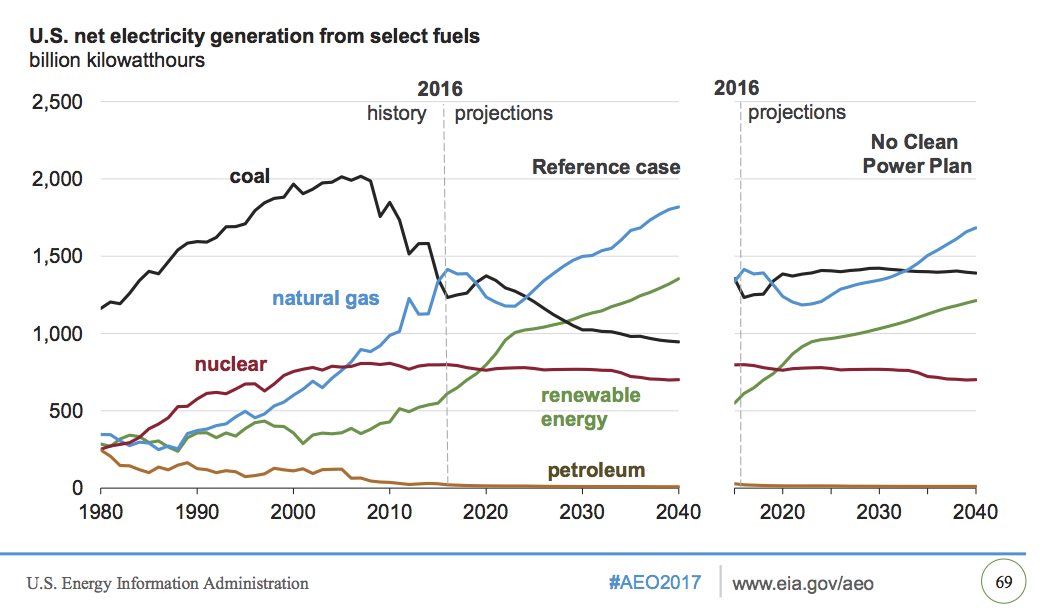
Relief to the coal industry is the other major pledge with policy implications. The Clean Power Plan (CPP) was a major policy measure that was expected to shape and refine energy consumption and power generation. The Energy Information Administration projects a 26% decline between 2015 and 2040 in coal production with CPP implementation. Without the CPP, they expect production to remain at 2015 levels.
Alternative energy
In conversation with Jaffe, she mentions that the majority of states are implementing the clean power plan because these clean energy initiatives were already in motion. She does not expect these states to reverse course. "Some utilities are moving away from coal because natural gas is cheaper, or because shareholders will not invest in coal generation," she notes.
Additionally, more Fortune 500 companies are committed to using clean energy. The Googles and Walmarts are announcing to stakeholders that they intend to be 100% renewable by certain dates. "Therefore, as a firm, you have to be in a state that supports renewables," she says.
There is a flip side, Jaffe refers to as a fault line, "But to have the renewables, there can be a problem if higher costs get kicked over to fixed income folks. The perception is that flush Google-type firms are benefiting from federal tax credits when they buy renewables, while some of the costs are borne in the overall rate base by regular, working people." This is an example of the rise of the contention between the 'elites versus the rest' that has changed the political landscape of late. Jaffe suggests, "There maybe some temporary reprieve from electricity reform [under Trump], but that may wind up being more about the pace of change than the fact that change is coming."
The climate change agenda is a broad and diffuse issue that has many arteries. In these initial days, and given the weight of other issues such as trade, security and economy, this item may not be a high priority for the administration. However, executive orders to roll back the Clean Power Plan, the Climate Action Plan and the Paris Agreement are said to be on the horizon.
Jaffe offers, "At UC Davis, we talk about “the three transportation revolutions” — automation, shared mobility and electrification. These technologies will come forward but not because of climate change policy. In both developing and developed countries, traffic congestion is a real problem. Firms like UPS and FedEx are using big data to save on fuel and labor costs, offers Jaffe. At UPS, after implementing computer-based route planning, they saved 100 million vehicle-miles traveled in the U.S. with that program. "If we were to cede [our advances in technology] to China, that would be a disaster for American jobs," says Jaffe.
"It remains to be seen how automation and clean technology shakes out with respect to economic planning over this Administration," observes Jaffe. "Politicization exists but energy technology and clean tech are important as a source of competitiveness in the U.S.," says Jaffe. Advances in technology have implications for military applications, cyber security, electricity grid security, and the movement of goods inside the U.S. Further, notes Jaffe, the movements of goods in the U.S. has a major influence on the competitiveness of exports, and the competition of manufacturing versus importing foreign goods. Thus, policies that have knock-on effects need to be fully scored.
U.S. Natural Gas on the Move
Re-published from Dialogues, United States Association for Energy Economics Over the next two decades, natural gas production grows and so does demand in the resource-rich U.S. The price of natural gas is expected to stay in a range of below $4, and climb to $5 for the next couple of decades, according to the Energy Information Administration's (EIA) 2017 outlook. "At the low end of the price range, this forecast reflects the incredible abundance of low-cost shale resources," says Ben Schlesinger, gas expert and professor at the University of Maryland.
Fields aplenty
The prolific Marcellus-Utica fields have greatly extended the resource potential of the United States. In a 2016 presentation, Schlesinger compared the Marcellus-Utica to Russia's Yamal Peninsula, its largest gas resource with annual potential production of 310-350 billion cubic meters (bcm). The Bovanenkovo field, the largest in the Yamal region, has potential production by 2030 of 220 bcm — the Marcellus was already producing 219 bcm in June of 2016, and now 233 bcm. Qatar's production was 181 bcm in 2015, with approximately 25.1 (trillion) tcm of estimated recoverable gas, compared to the Marcellus-Utica of 12.8 tcm. One difference: the Yamal region is in the Arctic in comparison to the Marcellus' near-suburban location of Pittsburg, Pennsylvania, cites Schlesinger, meaning a different and far lower cost structure and access.

Source: Ben Schlesinger Associates, 2016; EIA June 2016; Gazprom; BP 2016
Most Marcellus-Utica gas today is flowing south to meet Gulf Coast demand, west to Chicago, and northward into Central Canada. As Schlesinger points out though, pipeline capacity in the Northeast is still limited, by design, from states' energy choices. In addition to the Marcellus-Utica, more gas discoveries have come to light in the Permian Basin. Apache Corporation recently announced an estimated 75 trillion cubic feet (tcf) of rich gas in the Permian's furthermost corners of the Southern part of the Delaware Basin called the "Alpine High."
Gas movements
From natural gas demand and production growth, shale gas is expected to be the largest contributor to U.S. production growth to the year 2040. Schlesinger notes, "Demand grows around the Gulf Coast region because of industrial demand, LNG exports, demand from Mexico, and power plants. This gas is moving south. Price depends on how long the Marcellus-Utica holds out, and what new technologies come along."
The natural gas export story for the U.S. has already had twists and turns. According to the EIA 2017 forecasts, after 2020, U.S. exports of liquefied natural gas (LNG) grow at a more modest rate as U.S.-sourced LNG becomes less competitive in global energy markets. "I do not see the 16-20 bcf per day of exports as in earlier forecasts," Schlesinger assesses. "The U.S. regulators have approved enough LNG projects now to make us the largest exporter in the world by far —more than Qatar even. But some of these projects, and others waiting in the wings, are not fully subscribed and are on hold." Schlesinger suggests the U.S. will hit a certain level and then hold at that level, to see whether a second tranche of projects will see the light of day.
In 2016, total exports of U.S. natural gas were nearly 7 bcf per day.[i] Eagerly anticipated, the U.S. also began exporting liquefied natural gas in 2016 from the Cheniere-Sabine Pass facility, with ultimate capacity of over 4 bcf/d. [ii] Four more facilities are under construction. U.S. natural gas pipeline exports increased by 21.7% to 5.9 bcf/d in 2016, largely because of rising exports to Mexico.[iii] Part of Mexico's energy policy included in their five-year plan calls for the increased import of U.S. natural gas as the country grows it share of natural gas power generation. With the recent contentious political atmosphere between Mexico and the U.S., however, energy firms connected to the production and midstream side stand to lose out if trade and cooperation becomes imperiled.

Other regions in the world such as East Africa, China, and Argentina are keen to develop their own resources as well. Depletion, competition from other suppliers and technological advances will potentially keep the lid on LNG prices. "We are not going to flood the world with U.S. LNG," surmises Schlesinger.

Changeable energy
The energy scene is changing. Just as technology revolutionized drilling in the U.S., bringing a revolution to oil and gas producers and related industry, other energy forms are becoming more competitive. "Cost are down in solar energy, with many more installations on the horizon," observes Schlesinger. "This is wreaking havoc among some utilities. Then you couple batteries with solar energy and it will change how people power their homes in regions like the Sunbelt." While renewable energy forms displace coal-fired power generation, they also may curtail a portion of gas-fired generation as well, Schlesinger relayed.
Market pricing and competitive forces alongside technological change will constrain and influence energy production and choices. The market will drive America's energy mix, but new policy directives can potentially provide some tailwinds or opportunities to maximize profit for companies.
Jennifer is a writer and communications specialist focusing on energy, resources and thought leadership work for companies and institutions. Her work has appeared in numerous academic, policy and business publications.
[i] http://www.eia.gov/todayinenergy/detail.php?id=28932
[ii] https://www.eia.gov/naturalgas/weekly/archivenew_ngwu/2017/01_19/
Natural gas pipeline deliveries to the Sabine Pass liquefaction terminal averaged 1.9 Bcf/d for the report week, 14% higher than the week earlier. Pipeline deliveries set a new record on January 18 reaching 2.05 Bcf/d, indicating the start of the commissioning of Train 3.
[iii] http://www.eia.gov/todayinenergy/detail.php?id=28932